
Cheque Book Tracking by Speed Post: Debit & Credit Cards
Track a debit card, credit card, PIN mailer or cheque book sent by Speed Post. Get the number, read each status and know what to do if it goes back to the bank.
Waiting for a new debit card, credit card, PIN mailer or cheque book from your bank? This guide is for you. Most of the time you can follow it like any other Speed Post article: get the 13-character consignment number from your bank, then enter it on a tracker to see every step. If it does not arrive, you talk to your bank first and India Post second.
Below, we explain where the number comes from, what each status means for bank mail, and what to do if your card or cheque book is returned to the bank. You can check your number any time on the IndiaPostStatus Speed Post tracker.
Why Banks Send Cards and Cheque Books by Speed Post
Bank cards, PIN mailers and cheque books are sensitive. Banks want a service that records each step and can be traced. India Post’s Speed Post does this, and it now also covers the old Registered Post features. Learn more about the service on our Speed Post service page.
In August 2025, the Department of Posts said it had unified the processing of Registered and Speed Post items. It also said customers will continue to enjoy the benefits of registration under Speed Post. Read our guide on how Registered Post merged into Speed Post for the full story.
Two Speed Post add-ons matter a lot for bank mail:
- Registration (₹5 plus GST per item): the article is delivered only to the addressee or an authorised person.
- OTP-based delivery (₹5 plus GST per item): you get an OTP by SMS, and the postman hands over the article only after you share it.
Your bank decides which add-ons to use. If the postman asks for an OTP, it is the delivery OTP sent by India Post for that article. Never share your card PIN, CVV or any banking OTP with anyone.
Where Your Consignment Number Comes From
You do not book the Speed Post yourself. Your bank (or its card vendor) books it. So the consignment number starts with the bank, not with you.
Your bank may share the number in one of these ways:
- An SMS or email when the card or cheque book is dispatched.
- The card or cheque book request status in net banking or the mobile app.
- The bank’s customer care, if you call and ask for the dispatch details.
- Your home branch, if you ask in person.
The exact method differs from bank to bank. If you did not get a message, check your bank’s app first, then call your bank.
How to check that the number is correct
A Speed Post consignment number has 13 characters. It follows the international UPU S10 format: 2 letters, then 9 digits, then “IN” for India. A made-up example is EE123456789IN. If your number looks different, it may be a bank reference or a private courier number, not an India Post number. Our guide to India Post tracking numbers explains every part of the format.
How to Track Your Debit Card or Cheque Book: Step by Step
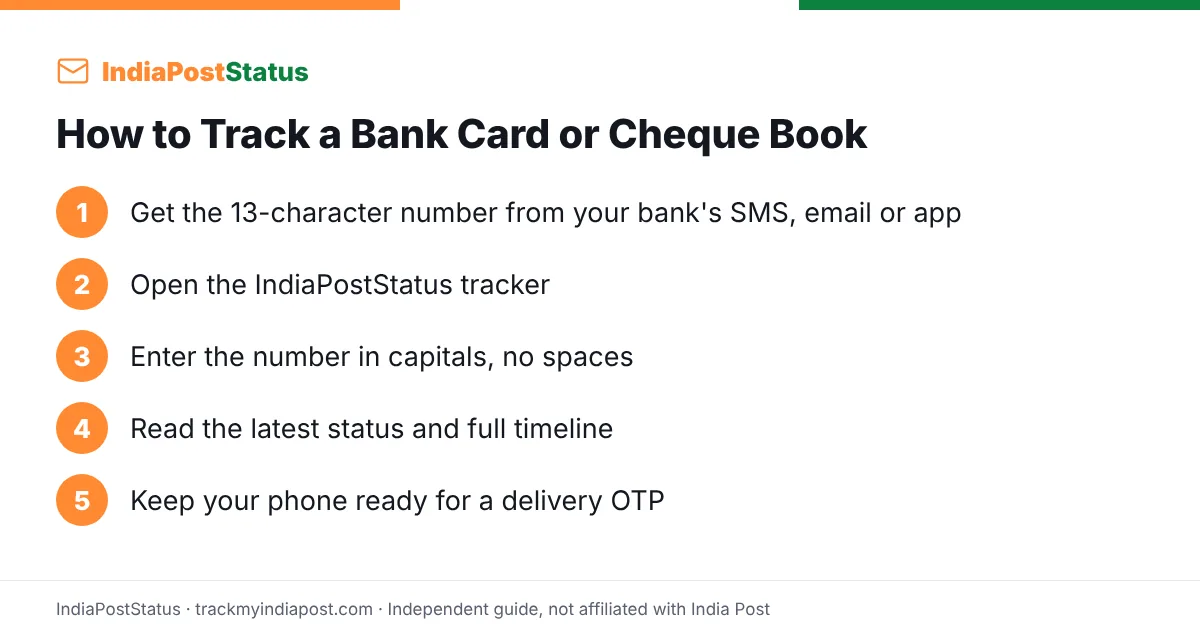
- Find the dispatch SMS, email or app entry from your bank and note the 13-character consignment number.
- Open the IndiaPostStatus tracking page on your phone or computer.
- Type the number in capital letters, with no spaces, and tap Track.
- Read the latest status at the top and the full timeline below it.
- Check that the destination post office matches your area. If it does not, call your bank to confirm the address on record.
- Keep your phone with you on the expected delivery day, in case an OTP is needed.
Tracking can take some time to show the first scan after the bank hands over a large batch. If the number shows nothing at first, check again later in the day.
Common Tracking Statuses for Bank Card Mail
The status names are the same as for any Speed Post article. Here is what the common ones mean for a card or cheque book, and what you should do. For the full list, see our guide to Speed Post tracking status meanings.
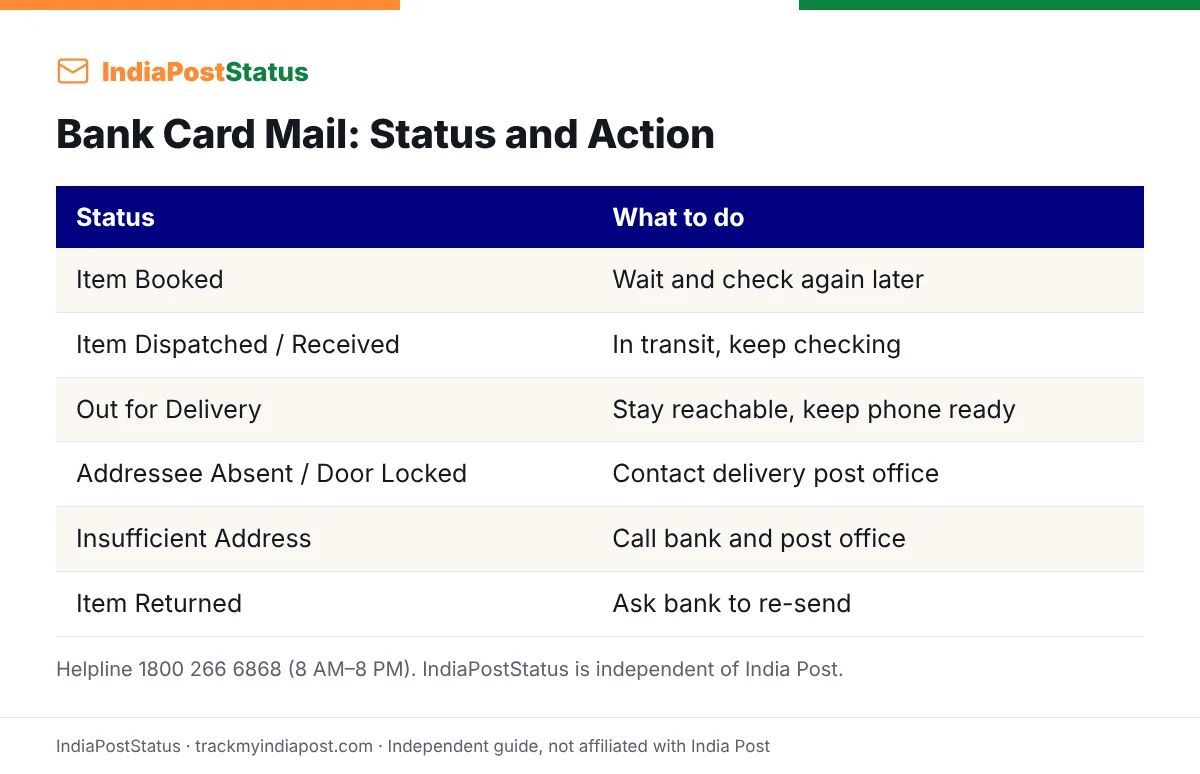
| Status | What it means | What you should do |
|---|---|---|
| Item Booked | The bank’s packet was accepted at the post office. | Nothing yet. Check again after a day. |
| Item Bagged / Item Dispatched | It is packed in a mail bag and moving to the next office. | Wait. It is in transit. |
| Item Received | It reached a new office on the route. | Check that the route is heading to your area. |
| Out for Delivery | The postman has it for delivery today. | Stay reachable. Keep ID and your phone ready. |
| Addressee Absent / Door Locked | Delivery was tried, but no one could receive it. | Contact your delivery post office quickly to collect or ask for another attempt. |
| Insufficient Address / Addressee Moved | The postman could not find you at the address. | Call your bank and the delivery post office. Update your address with the bank. |
| Item Returned / Item Delivered (to Sender) | The packet is going back, or has gone back, to the bank. | Contact your bank to ask for a re-dispatch or branch collection. |
What to Do If Your Card or Cheque Book Is Not Delivered
If it is stuck in transit
If there is no new scan for several working days, first ask your bank whether there is any known delay. Then contact India Post with your consignment number. The India Post helpline is 1800 266 6868, open 8 AM to 8 PM, and the IVRS works 24×7.
If delivery failed at your address
Visit or call your delivery post office with your ID and the consignment number. Ask if the item is on hold and whether you can collect it. Act fast, because undelivered items are not held forever and may be sent back to the sender.
If it was returned to the bank
When the status shows the item returned or delivered to the sender, your card or cheque book is back with your bank. What happens next depends on your bank. It may re-send it, ask you to collect it from the branch, or cancel it and issue a new one. Call your bank or visit your branch, and confirm your current address before it is sent again.
If you think it is lost or opened
If the tracking shows delivered but you never got it, or the envelope looks tampered with, call your bank at once. Ask them to block the card or stop the cheque leaves. Then file a complaint with India Post.
How to File a Complaint
You can raise a complaint with India Post in three ways:
- Online, through the India Post complaint page.
- At your nearest post office, where you get an acknowledgement.
- By phone, on the helpline 1800 266 6868.
India Post’s complaint guidelines say a complaint can be filed after the service’s delivery norm has passed, and within 60 days of the transaction. If your complaint is not settled in a reasonable time, you can escalate it to the Circle Nodal Officer. You can also raise a grievance on the Government’s CPGRAMS public grievance portal.
On compensation, India Post’s Speed Post service page says a delay is compensated with the Speed Post charges. For loss, pilferage or damage, it pays double the Speed Post charges or ₹1,000, whichever is less. Since your bank paid for the Speed Post, keep your bank in the loop too. Our step-by-step guide on Speed Post complaints for lost or delayed items covers the process in detail.
Quick Safety Tips for Bank Mail
- Keep your mobile number and address updated with your bank before you request a new card or cheque book.
- Your bank may send the PIN mailer separately, or let you set the PIN in its app or at an ATM. Follow your bank’s instructions.
- Never share your card PIN, CVV or banking OTP with the postman or anyone else. The delivery OTP is only for that one article.
- If a PIN mailer or cheque book envelope looks torn or opened, contact your bank before using it.
Disclaimer: IndiaPostStatus is an independent website and is not affiliated with India Post or the Department of Posts. Rates, rules and dates change often, so always verify the information on the official India Post website, indiapost.gov.in, before you act.
Frequently Asked Questions
How do I get the Speed Post number for my debit card?
Your bank books the Speed Post, so it has the number. Check your dispatch SMS or email, your card status in net banking or the app, or call your bank.
Can I track my cheque book with my account number?
No. India Post tracking works only with the 13-character consignment number, such as EE123456789IN. Ask your bank for that number.
Why does the postman ask for an OTP?
Your bank may have booked the item with OTP-based delivery. India Post sends an OTP by SMS, and the postman hands over the item only after you share it. Never share your card PIN or a banking OTP.
My card was returned to the bank. What now?
Contact your bank or home branch. Depending on its rules, it may re-send the card, ask you to collect it, or issue a new one. Confirm your address first.
Who do I complain to if my card is lost in the post?
Tell your bank first so it can block the card. Then file a complaint with India Post online, at a post office or on 1800 266 6868, within 60 days of the transaction.
Got your consignment number? Track your card, PIN mailer or cheque book now on the IndiaPostStatus tracker and see every step of its journey.