Registered Post Merged with Speed Post: What Changed and How OTP Delivery Works
India Post merged domestic Registered Post into Speed Post. Learn what changed, how the ₹5 Registration and OTP delivery add-ons work, and how to send official letters now.
For generations, Indians relied on Registered Post for legal notices, bank letters, job offers and government correspondence. In 2025, India Post made one of its biggest changes in decades: domestic Registered Post was merged into Speed Post, and “Registration” became an optional add-on to Speed Post. At the same time, India Post introduced OTP-based delivery and other new features.
If you are wondering where Registered Post went, how to send an official letter now, or what OTP delivery means for you, this guide explains everything in simple terms.
Why Did India Post Merge Registered Post with Speed Post?
Registered Post and Speed Post served overlapping needs. Both were trackable, both offered proof of delivery, and both were used for important documents. Running them as separate networks meant duplicated processing. By merging them, India Post can:
- Process all accountable mail through the faster Speed Post network.
- Offer one simple product with optional security add-ons.
- Give every customer real-time tracking and SMS updates.
- Invest in technology such as OTP delivery and online booking.
The Speed Post document tariff itself was revised from 1 October 2025, its first revision since 2012, to support these improvements.
What Exactly Changed?
Here are the key changes for customers:
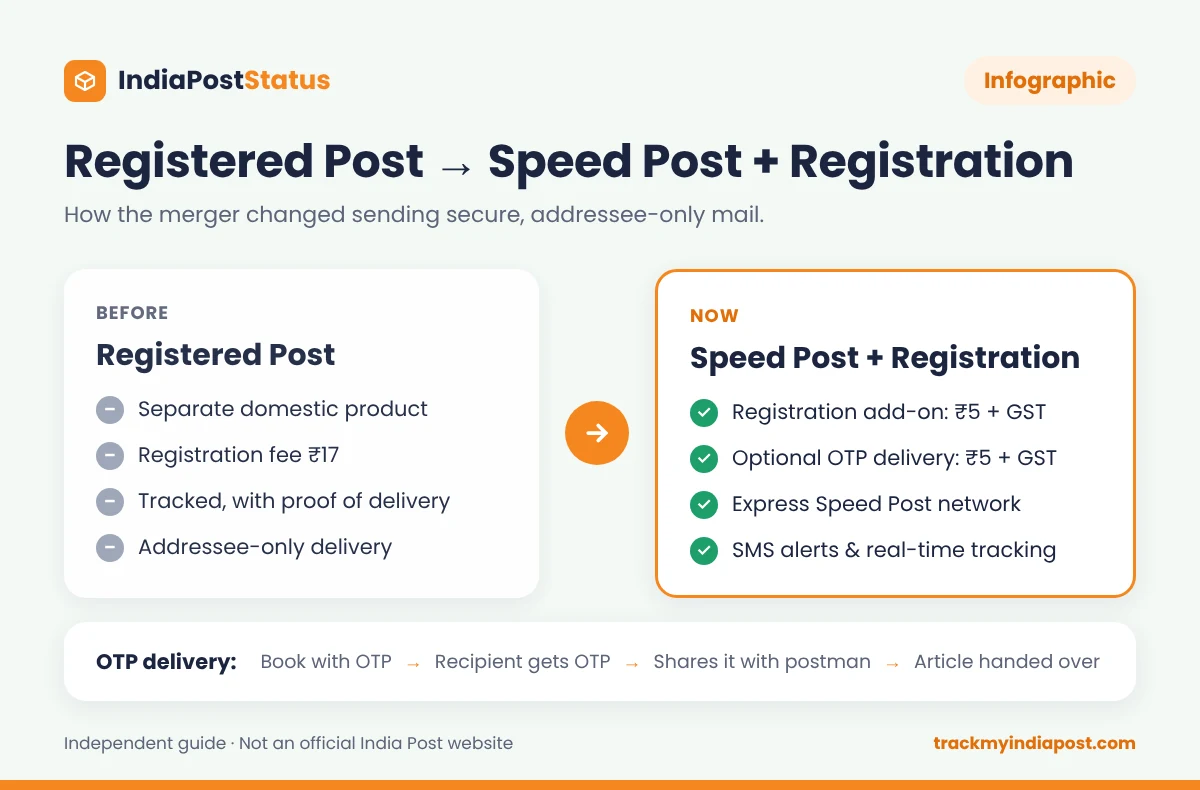
- No separate domestic Registered Post product: you now book Speed Post and choose “Registration” if you need addressee-only delivery.
- Cheaper registration: the registration charge was reduced from ₹17 to ₹5 per article (plus GST).
- Faster delivery: registered articles now travel through the Speed Post network.
- New OTP delivery option: for ₹5 plus GST, the article is handed over only after the recipient shares a one-time password.
- Better notifications: SMS delivery alerts and real-time tracking updates.
- Online booking and payment options for added convenience.
How the Registration Add-On Works
When you book a Speed Post document or parcel with Registration, the article is delivered only to the addressee or a person duly authorised by the addressee. This keeps the legal value that people associated with Registered Post – proof that a specific person received the article – while delivering faster.
Registration is ideal for:
- Legal notices and court documents.
- Bank and insurance correspondence.
- Appointment letters, offer letters and official replies to government offices.
- Original certificates, mark sheets and identity documents.
How OTP-Based Speed Post Delivery Works
OTP delivery adds a digital layer of security. Here is what happens:
- The sender books Speed Post with the OTP delivery option and provides the recipient’s mobile number.
- When the article is out for delivery, the recipient receives a one-time password on that mobile number.
- The recipient shares the OTP with the postman at the time of delivery.
- The postman verifies the OTP, and only then hands over the article. The delivery is recorded in the tracking history.
Because the article cannot be handed over without the OTP, this option significantly reduces the risk of wrong delivery. The charge is ₹5 per article plus GST.
How to Send a “Registered” Letter Now: Step-by-Step
- Write the full address with the correct PIN code and the recipient’s mobile number.
- At the post office counter, ask for Speed Post with Registration (and OTP delivery if needed).
- Request an acknowledgement or proof of delivery if you need it for legal purposes.
- Pay the Speed Post tariff plus ₹5 for each add-on and GST.
- Keep the receipt and note the consignment number.
- Track the article using our India Post tracking tool until it shows “Item Delivered”.
How Much Does It Cost Now?
For a typical document up to 50 grams, the Speed Post charge is ₹19 locally and ₹47 to anywhere else in India. Adding Registration costs ₹5, so a registered letter sent to another city costs ₹52 plus GST. Add OTP delivery for another ₹5. See the full weight-wise table in our Speed Post charges 2026 guide.
What About Old Registered Post Articles?
Articles booked under the older Registered Post format, usually with consignment numbers starting with “R”, can still be tracked using the same tracking tools. Proof of delivery records for older articles remain available through India Post.
Is Speed Post with Registration Valid for Legal Notices?
Speed Post with Registration is designed to provide addressee-specific delivery with proof, which is why it has replaced Registered Post for official use. Many organisations already accepted Speed Post for legal and official communication. However, if a particular court, contract or law specifically names a mode of service, check with a lawyer or the relevant authority about current requirements.
Benefits for Senders and Recipients
- Speed: registered articles now move on the express Speed Post network.
- Security: addressee-only and OTP delivery options reduce misdelivery.
- Transparency: real-time tracking and SMS alerts at every step.
- Affordability: registration now costs ₹5 instead of ₹17.
Common Myths About the Registered Post Merger
Myth 1: “There is no secure post any more.”
Not true. Secure, addressee-only delivery still exists – it is now called Speed Post with Registration. With the new OTP delivery option, it is arguably more secure than before.
Myth 2: “Sending an official letter is now much more expensive.”
For most local letters, the cost is very similar. The Speed Post tariff starts at ₹19 locally, and the registration fee has dropped from ₹17 to ₹5. For outstation letters you pay more than the old Registered Post rate, but you also get faster, express delivery and SMS updates.
Myth 3: “Every Speed Post article now needs an OTP.”
OTP delivery is optional. You choose it only when you want the extra verification step.
Tips for Businesses and Offices
Organisations that send large volumes of notices, statements or certificates should update their dispatch processes. Train front-desk and mailroom staff to ask for “Speed Post with Registration” instead of “Registered Post”, always capture the recipient’s mobile number for OTP and SMS alerts, and store consignment numbers alongside customer records. Bulk senders can also open a Speed Post contract account; new bulk customers are eligible for a special 5% discount on the tariff.
Final Thoughts
The merger of Registered Post into Speed Post gives customers faster delivery, cheaper registration and new security options like OTP verification. For important documents, simply book Speed Post with Registration or OTP delivery and track it online. Unsure what your tracking updates mean? Read our guide to Speed Post tracking status meanings.
Frequently Asked Questions
Is Registered Post discontinued in India?
Domestic Registered Post has been merged into Speed Post. Instead of a separate service, customers now book Speed Post and add the Registration option for addressee-only delivery.
What is the charge for Registration in Speed Post?
Registration costs ₹5 per Speed Post item (document or parcel) plus applicable GST.
What is OTP delivery in Speed Post?
OTP delivery is a value-added service where the article is handed over only after the recipient shares the one-time password sent to their mobile with the postman. It costs ₹5 plus GST.
Can I still track my old Registered Post article?
Yes. Older registered articles, which usually start with the letter R, can be tracked with the same India Post tracking tools using their 13-character consignment number.