Speed Post Charges 2026: Latest Document & Parcel Rate Chart
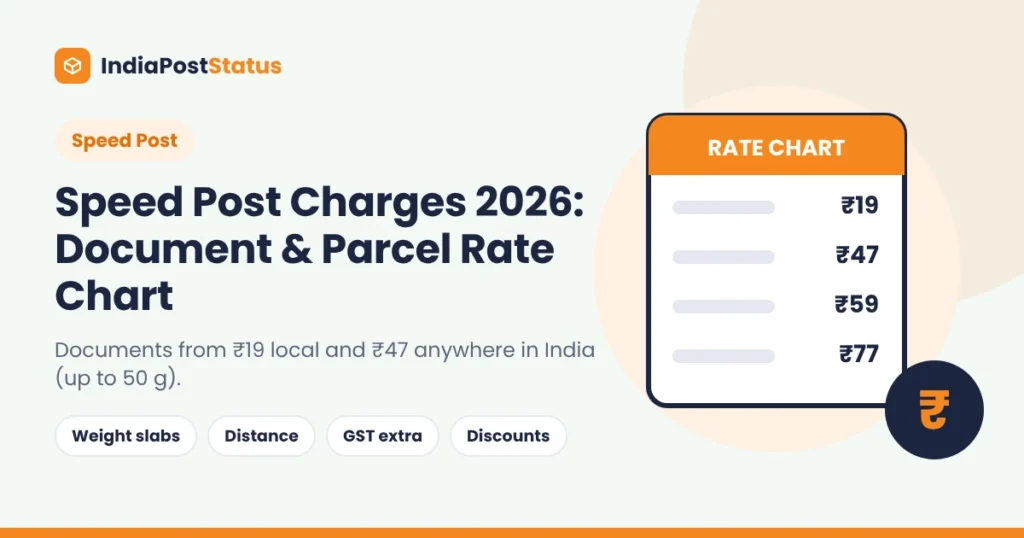
Speed Post charges 2026: documents from ₹19 local and ₹47 anywhere in India (up to 50 g). See the full weight and distance rate chart, parcel rates, GST and discounts.
Planning to send a document or parcel and want to know how much Speed Post will cost? India Post revised its Speed Post tariff for documents from 1 October 2025 – the first revision since 2012 – and introduced a new zone-based tariff for parcels from 1 August 2026. This guide brings together the latest Speed Post charges for 2026, explains how the price is calculated, and shows you how to save money on every booking.
How Are Speed Post Charges Calculated?
Speed Post pricing depends on three main factors:
- Weight of the article, measured in weight slabs (for example, up to 50 g, 51–250 g, 251–500 g).
- Distance or destination zone – local delivery is the cheapest, and the charge rises as the distance increases.
- Type of article – documents and parcels have separate tariffs.
On top of the base tariff, GST is charged extra as applicable, and optional value-added services such as Registration, OTP delivery or insurance cost more.
Speed Post Document Charges 2026
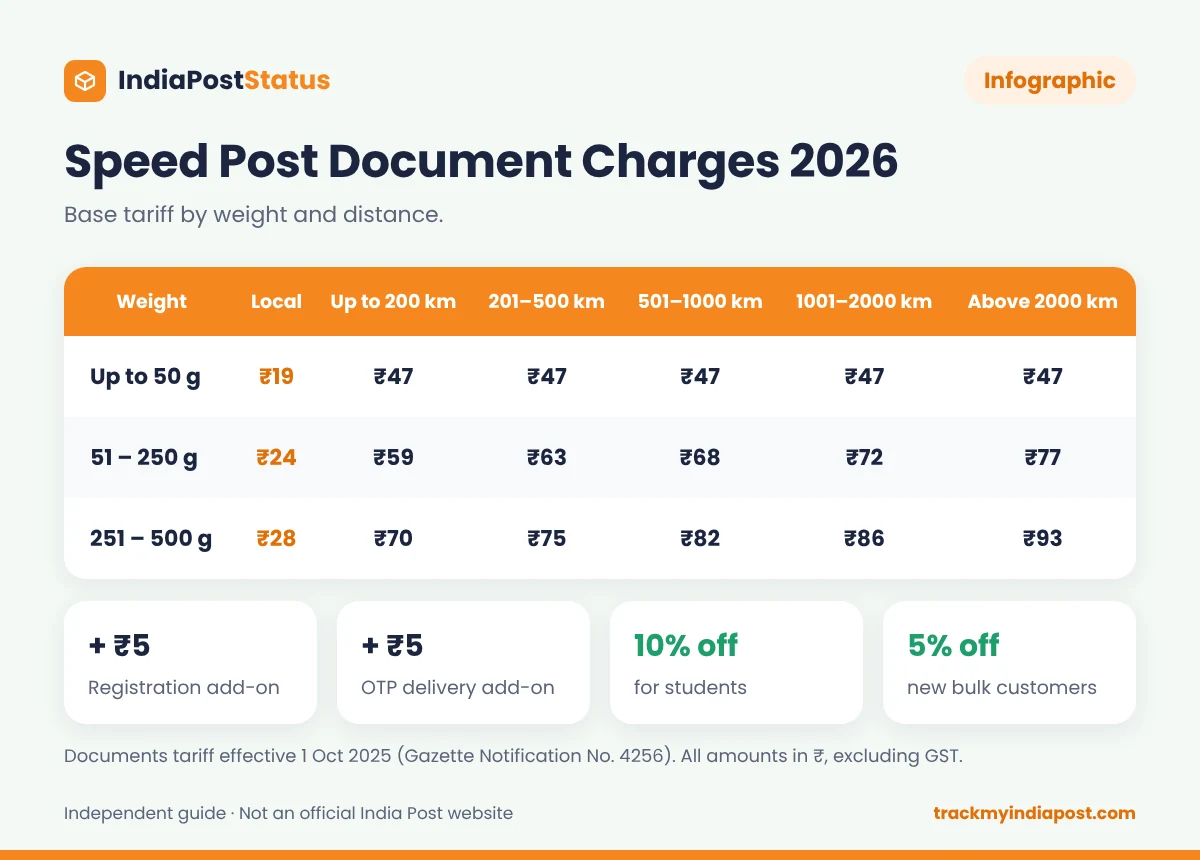
The following official tariff for Speed Post documents has been in force since 1 October 2025, as notified in Gazette Notification No. 4256 dated 25 September 2025. All amounts are in rupees and exclude GST.
| Weight | Local | Up to 200 km | 201–500 km | 501–1000 km | 1001–2000 km | Above 2000 km |
|---|---|---|---|---|---|---|
| Up to 50 g | ₹19 | ₹47 | ₹47 | ₹47 | ₹47 | ₹47 |
| 51 g – 250 g | ₹24 | ₹59 | ₹63 | ₹68 | ₹72 | ₹77 |
| 251 g – 500 g | ₹28 | ₹70 | ₹75 | ₹82 | ₹86 | ₹93 |
For most letters, certificates and application forms weighing under 50 grams, you will therefore pay ₹19 for local delivery and a flat ₹47 for delivery anywhere else in India, plus GST.
Speed Post Parcel Charges 2026
From 1 August 2026, India Post moved Speed Post Parcel to a zone-based structure. Instead of distance bands in kilometres, parcels are now priced by destination category: Local, Within State, Zone/Metro and Other States. Charges increase in slabs of 500 grams.
For the first slab (up to 500 g), the commonly published retail rates are approximately:
| Destination | Up to 500 g (approx.) |
|---|---|
| Local | ₹28 |
| Within State | ₹76 |
| Zone / Metro | ₹82 |
| Other States | ₹90 |
Each additional 500 g adds a further charge depending on the zone. Because parcel tariffs vary with weight, destination and any contract discount, always confirm the final price using the official India Post postage calculator or at the post office counter before booking.
Value-Added Services and Their Cost
Since the merger of Registered Post into Speed Post, you can add extra security to any Speed Post document or parcel:
- Registration – ₹5 per item + GST: the article is delivered only to the addressee or a person authorised by them.
- OTP Delivery – ₹5 per item + GST: the postman hands over the article only after the recipient confirms a one-time password.
- Insurance: available for valuable articles at an additional charge based on the declared value.
- Acknowledgement / Proof of Delivery: useful for legal and official correspondence.
Discounts on Speed Post
India Post offers a few ways to pay less:
- Students: a 10% discount on the Speed Post tariff.
- New bulk customers: a special 5% discount.
- Contract/business customers: volume-based discounts for regular senders such as e-commerce sellers, banks and educational institutions.
Speed Post Charges Examples
Here are a few quick examples (excluding GST) based on the document tariff:
- A 30 g job application sent within the same city: ₹19.
- A 30 g admit card from Delhi to Chennai: ₹47.
- A 200 g file of documents sent 800 km away: ₹68.
- A 450 g legal document bundle sent 2,200 km with Registration: ₹93 + ₹5 = ₹98.
How to Calculate Speed Post Charges Before You Visit the Post Office
You do not need to guess the price. Follow these simple steps to estimate your Speed Post charges at home:
- Weigh the article with a kitchen or postal scale, including the envelope or packaging.
- Identify the article type – a document (papers, certificates, letters) or a parcel (goods, books, gifts).
- Check the distance or destination zone – local, within your state, a metro or zone city, or another state.
- Match the weight slab in the rate chart above to find the base charge.
- Add optional services such as Registration or OTP delivery, then add GST.
The official India Post postage calculator on indiapost.gov.in gives the exact amount once you enter the origin and destination PIN codes, weight and service type. The counter clerk will always weigh the article again, so the final amount on your receipt is the one that counts.
What Changed for Registered Post Users?
Registered Post as a separate domestic service has been merged into Speed Post. Customers who earlier used Registered Post for official letters now book Speed Post and add the “Registration” option. The registration charge itself was reduced from ₹17 to ₹5 per article, so the combined cost of a fast, trackable and addressee-only delivery is now easy to calculate: the Speed Post tariff plus ₹5 and GST. This is especially useful for legal notices, bank letters and government correspondence that need proof of delivery to a specific person.
Is Speed Post Cheaper Than a Private Courier?
For light documents, Speed Post is usually one of the most affordable options for nationwide delivery, especially to small towns and rural PIN codes where private couriers may charge extra or not deliver at all. Speed Post also offers official proof of delivery, which many government offices, courts and universities prefer. For heavy or very urgent consignments within metros, compare rates and delivery times before choosing.
Tips to Save Money on Speed Post
- Weigh your article at home and trim extra packaging to stay inside a lower weight slab.
- Use a thin, strong envelope for documents instead of a box.
- Ask about the student discount if you are sending exam or admission documents.
- Open a contract account if you send articles regularly.
- Add Registration or OTP only when the item truly needs addressee-only delivery.
Final Thoughts
With documents starting at just ₹19 locally and ₹47 nationwide, Speed Post remains one of the most economical ways to send mail across India. Once you have booked, keep your receipt and follow your article using our Speed Post tracking tool. New to tracking? Read our step-by-step Speed Post tracking guide.
Frequently Asked Questions
What is the minimum Speed Post charge in 2026?
For documents up to 50 grams, Speed Post costs ₹19 for local delivery and ₹47 for delivery anywhere else in India, plus applicable GST.
Is GST included in Speed Post charges?
No. The published Speed Post tariff excludes GST, which is charged extra as applicable at the time of booking.
How much does it cost to add Registration to Speed Post?
Registration is a value-added service that costs ₹5 per Speed Post item plus GST. The item is delivered only to the addressee or their authorised person.
Do students get a discount on Speed Post?
Yes. India Post offers students a 10% discount on the Speed Post tariff.
When were Speed Post charges last revised?
Speed Post document charges were revised from 1 October 2025, and Speed Post Parcel charges moved to a zone-based tariff from 1 August 2026.