India Post GDS: Job Profile, Salary, Duties & Eligibility Explained
What is an India Post GDS (Gramin Dak Sevak)? Learn the difference between BPM, ABPM and Dak Sevak, their duties, TRCA salary, working hours, eligibility and how GDS selection works.
India Post GDS stands for Gramin Dak Sevak, the backbone of postal services in rural India. GDS employees run branch post offices in villages, deliver letters and parcels, sell postal products and handle India Post Payments Bank (IPPB) transactions at the doorstep. Every year India Post engages thousands of GDS candidates, and the job is popular because selection is based only on 10th class marks.
This guide explains what a GDS does, the three types of GDS posts, salary (TRCA), working hours, eligibility and how you can apply.
What Is a Gramin Dak Sevak (GDS)?
A Gramin Dak Sevak is engaged by the Department of Posts to work in rural Branch Post Offices (BOs). GDS employees are governed by the GDS (Conduct and Engagement) Rules, 2020. They are not regular departmental employees: they work a minimum of four and a maximum of five hours a day, are paid a Time Related Continuity Allowance (TRCA), and can continue until the age of 65. Since the job is part-time, a GDS is expected to have another source of livelihood as well.
Types of GDS Posts
There are three categories of GDS posts:
1. Branch Postmaster (BPM)
- Manages day-to-day operations of the Branch Post Office and IPPB services.
- Markets and promotes postal products and services.
- In single-handed branch offices, is responsible for the entire office, including mail conveyance and delivery.
- Must provide accommodation for the Branch Post Office and live in the post village.
2. Assistant Branch Postmaster (ABPM)
- Sells stamps and stationery.
- Conveys and delivers mail at the doorstep and exchanges mail with the account office.
- Handles IPPB deposits, payments and other transactions.
- Assists the BPM and does any other work assigned by supervisors.
3. Dak Sevak
- Works in departmental post offices (sub post offices and head post offices).
- Supports mail handling, delivery and counter work as assigned by the Postmaster.
India Post GDS Salary (TRCA)
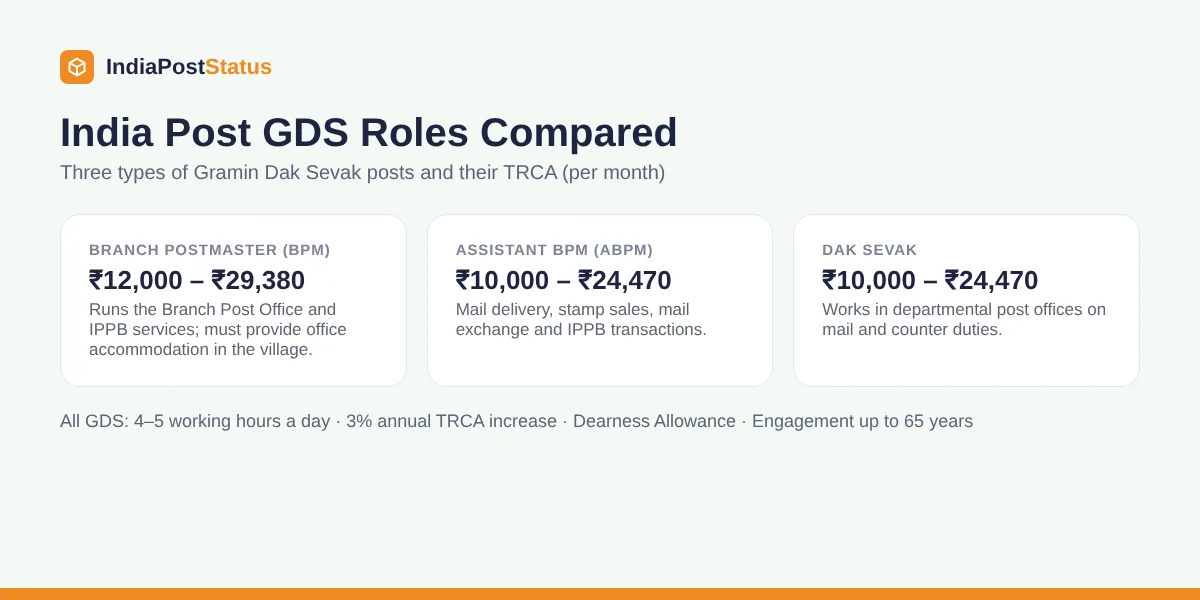
GDS employees receive TRCA instead of a pay scale. According to the latest GDS notification (Schedule-II, July 2026):
| Post | TRCA per month |
|---|---|
| Branch Postmaster (BPM) | ₹12,000 – ₹29,380 |
| ABPM / Dak Sevak | ₹10,000 – ₹24,470 |
On top of TRCA, GDS employees receive Dearness Allowance as announced by the Government. TRCA increases by 3% every year (subject to conditions), and GDS are covered by the GDS Gratuity and the Service Discharge Benefit Scheme, which works like the National Pension System for regular employees.
GDS Eligibility at a Glance
| Criteria | Requirement |
|---|---|
| Age | 18 to 40 years (relaxation: SC/ST 5 yrs, OBC 3 yrs, PwBD 10 yrs) |
| Education | 10th pass with passing marks in Mathematics and English |
| Local language | Must have studied the local language up to 10th |
| Other skills | Basic computer knowledge and cycling |
| Livelihood | Adequate means of livelihood |
How GDS Selection Works
There is no written exam or interview. India Post prepares a system-generated merit list from 10th class marks. Shortlisted candidates go through physical document verification at the Divisional office and are then engaged. Applications are made only online through the official GDS portal at indiapost.gov.in/gdsonlineengagement.
For the latest vacancy numbers and dates, read our guide on India Post GDS Recruitment 2026.
Pros and Cons of a GDS Job
Pros
- Government engagement close to home, especially in villages.
- No exam; selection on 10th marks.
- Fixed working hours, leaving time for other work.
- Annual TRCA increment, DA and gratuity benefits.
Cons
- It is not a regular government job, and TRCA is lower than regular postal salaries.
- BPMs must arrange office accommodation in the village.
- Work involves field duty in all weather, including mail delivery by cycle.
Career Growth
GDS employees with the required qualifications can appear in departmental examinations for posts such as Postman/Mail Guard and Multi-Tasking Staff (MTS), as per the recruitment rules in force. This is one of the main reasons many young candidates join as GDS.
FAQs
What is the full form of GDS in India Post?
GDS stands for Gramin Dak Sevak.
Is India Post GDS a government job?
GDS is an engagement under the Department of Posts governed by the GDS (Conduct and Engagement) Rules, 2020. It is not a regular departmental post but comes with TRCA, DA and other benefits.
What is the working time of a GDS?
A GDS works a minimum of four hours and a maximum of five hours a day.
What is the difference between BPM and ABPM?
The BPM runs the branch post office and is responsible for its operations, while the ABPM handles mail delivery, stamp sales and IPPB transactions and assists the BPM.
Up to what age can a GDS work?
A GDS can be retained up to 65 years of age.
Disclaimer: TrackMyIndiaPost is an independent information website and is not affiliated with India Post or the Department of Posts.